

-
"The liturgical year is not an idle discipline, not a sentimentalist's definition of piety, not an historical anachronism. It is Jesus with us, for us, and in us as we strive to make His life our own. It is goad and guide to the kind of personal spirituality that is worthy of the Jesus whose commitment to the Word of God led Him all the way to the cross and beyond it - to Resurrection. It is, without a doubt, learning to live the liturgical year that makes a difference to every other year of our lives."
(Joan Chittister, The Liturgical Year)
-
Showing posts with label liturgy. Show all posts
Showing posts with label liturgy. Show all posts
Sunday, January 2, 2011

Wednesday, July 28, 2010
eighteen
-

-
"O God, my times are in your hand: look with favor, I pray, on your servant, as I begin another year. Grant that I may grow in wisdom and grace, and strengthen my trust in your goodness all the days of my life; through Jesus Christ our Lord. Amen."
-
(The Book of Common Prayer)
-

-
"O God, my times are in your hand: look with favor, I pray, on your servant, as I begin another year. Grant that I may grow in wisdom and grace, and strengthen my trust in your goodness all the days of my life; through Jesus Christ our Lord. Amen."
-
(The Book of Common Prayer)
-
Thursday, March 25, 2010
bread that satisfies
-
Come, everyone who thirsts,
come to the waters;
and he who has no money,
come, buy, and eat!
Come, buy wine and milk
without money and without price.
-
Come, everyone who thirsts,
come to the waters;
and he who has no money,
come, buy, and eat!
Come, buy wine and milk
without money and without price.
-
As I mentioned previously, part of my focus for this Lenten season has been Christ as the Bread of Life. By choosing to fast from bread, I have sought to understand more fully the only sustenance that I truly need. I have sought to consider and set aside all those earthly pleasures through which I so often seek my satisfaction and worth.
-
-
Why do you spend your money
for that which is not bread,
and your labor,
for that which does not satisfy?
Listen diligently to me,
and eat what is good,
and delight yourselves in rich food.
Incline your ear, and come to me;
hear, that your soul may live.
-
for that which is not bread,
and your labor,
for that which does not satisfy?
Listen diligently to me,
and eat what is good,
and delight yourselves in rich food.
Incline your ear, and come to me;
hear, that your soul may live.
-
So often I spend my money, my labor, and my time on that which is not the true Bread of Life, attempting to feed my soul with that which does not satisfy. Often this temptation comes in the form of relationships or food. For me this temptation most often comes in the form of schedule, routine, and discipline. I seek my sense of worth, my pleasure, my satisfaction, my bread, in my ability to live up to my own self-imposed standards.
-
And so this time of Lent has been a time set aside for repentance, for turning away and forsaking those things that I so often rely on for my sustenance, for abstaining from those movies and books that I turn to for a quick fix of pleasure, for learning to live the day God has given me rather than seeking my worth in controlling my schedule, for learning to love others out of self-sacrifice rather than seeking them to satisfy my own insecurities, for realizing again the abundant grace of God, knowing that the bread and wine, his body and blood, are truly all that I need.
-
-
And so this time of Lent has been a time set aside for repentance, for turning away and forsaking those things that I so often rely on for my sustenance, for abstaining from those movies and books that I turn to for a quick fix of pleasure, for learning to live the day God has given me rather than seeking my worth in controlling my schedule, for learning to love others out of self-sacrifice rather than seeking them to satisfy my own insecurities, for realizing again the abundant grace of God, knowing that the bread and wine, his body and blood, are truly all that I need.
-
Seek the Lord while he may be found;
call upon him while he is near;
let the wicked forsake his way,
and the unrighteous man his thoughts;
let him return to the Lord,
that he may have compassion on him,
and to our God,
for he will abundantly pardon.
-
call upon him while he is near;
let the wicked forsake his way,
and the unrighteous man his thoughts;
let him return to the Lord,
that he may have compassion on him,
and to our God,
for he will abundantly pardon.
-
And yet, with repentance, I often feel a sense of despair over my own lack of progress. I expect myself to change and yet I fall back into my old ways. However, I read somewhere recently, that when we repent we must always "seek out the promise." We must remember that God hears our prayers of repentance and will continue the work he has begun in us. We must remember that he is planting seeds within us that will sprout and grow and accomplish all of his purposes. We must remember that when we ask for the Bread of Life, he promises to nourish us with what is good and rich.
-
-
For as the rain and the snow come down from heaven
and do not return there but water the earth,
making it break forth and sprout,
giving seed to the sower and bread to the eater,
so shall my word be that goes out from my mouth;
it shall not return to me empty,
but it shall accomplish that which I purpose,
and shall succeed in the thing for which I sent it.
-
(Isaiah 55:1-3, 6-7, 10-11)
-
----
and do not return there but water the earth,
making it break forth and sprout,
giving seed to the sower and bread to the eater,
so shall my word be that goes out from my mouth;
it shall not return to me empty,
but it shall accomplish that which I purpose,
and shall succeed in the thing for which I sent it.
-
(Isaiah 55:1-3, 6-7, 10-11)
-
----
Sunday, March 21, 2010
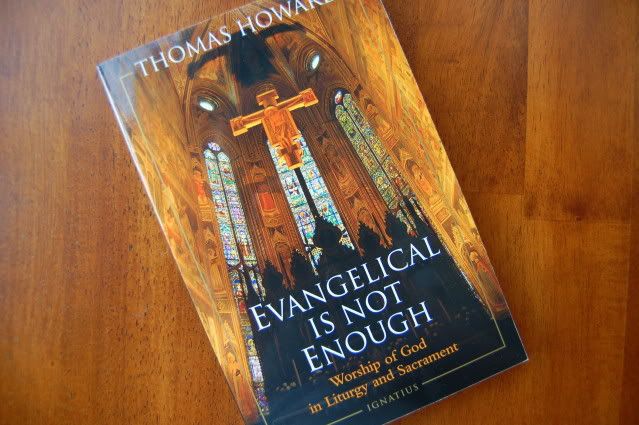
book of the week | evangelical is not enough
-

-
week five | book of the week | evangelical is not enough
-
week five | book of the week | evangelical is not enough
-
I first heard about Evangelical is Not Enough: Worship of God in Liturgy and Sacrament through Elizabeth Esther's online book club. I was intrigued, but didn't bother to look into it further. Later in January, a friend mentioned something else about it and suggested that I read it, so I found a copy and delved into it. The book tells the story of Thomas Howard (who, incidentally, is Elisabeth Elliot's brother) and "his pilgrimage from Evangelicalism (which he loves and reveres as the religion of his youth) to liturgical Christianity."
-
As I've mentioned before, I have begun my own little journey towards the more liturgical traditions. But I still feel like so many of the reasons I am attracted to the liturgy and the sacraments are still fuzzy in my mind, for I was attracted to it all before I could even explain why. When the shocked girls in my ballet class inquired this past December why I was now attending the "boring" Episcopal church, I found it difficult to articulate my answer. So I hoped reading Thomas Howard's journey would help clarify my own journey somewhat. And I think it did.
-
Having said that, let me mention that I really don't feel like I read this book closely enough. It's on my "need to read again" shelf. But that's the case primarily because it was such a good book, one that I think held more in it than I was able to comprehend in one week (and in the early mornings, no less, when my primary goal was just trying to keep my eyes open).
-
The book is directed towards Evangelicals who have an interest in the liturgical church and who have perhaps grown weary with some aspects of Evangelicalism. There are a lot of books out there today that seem to address people who have "grown weary with Evangelicalism." But I think one of the things that makes this book unique is that Howard clearly expresses his appreciation and respect for the Evangelicalism of his youth. He does not immediately start discussing all the wrong things about Evangelicalism, but rather states right away that his "debt to Protestantism is incalculable." And he carries this same attitude throughout the entire book--he discusses the reasons he is drawn to liturgy with an appealing honesty and grace towards all.
-
In the first chapter, Howard takes a moment to define Evangelicals. I found rather amusing the list of "touchstones" he uses to explain the Evangelical identity--perhaps because it is all so familiar--everything from Billy Graham and Wheaton College to an emphasis on the Second Coming or missions. The rest of the chapters deal individually with different aspects of of the liturgical tradition that attracted him, from ordered prayer to worship as an act rather than an experience. See the full list of all of the chapters below.
-
I do not have the time or the space to write about the specific ways this book has helped to clarify my own journey towards liturgy, so I am thinking that perhaps I will have to start in the future a little series of posts listing some of those reasons (for my own sake, mostly--then I'll know how to answer people better!). But if you'd like to read more about the book, there is a lot of information and discussion over at Elizabeth Esther. And no doubt you'll see me quoting from it again in the near future--it is a book I find myself returning to over and over.
-
Book Information:
Published in 1984 by Ignatius Press
158 pages
10 chapters:
---1. Protestant and Evangelical: Understanding Ourselves
---2. Spirit and Flesh: Surrendered Forever or Reunited?
---3. Christian Worship: Act or Experience?
---4. Prayer: Random or Disciplined?
---5. Hail, Blessed Virgin Mary: What Did the Angel Mean?
---6. Ritual or Ceremony: A Dead Hand or the Liberty of the Spirit?
---7. Table and Altar: Supper and Sacrament
---8. The Eucharistic Liturgy: Diagram and Drama
---9. The Liturgical Year: Redeeming the Time
---10. Envoi
Postcript, Notes, & Further Reading
Price: $10.36
-
-
As I've mentioned before, I have begun my own little journey towards the more liturgical traditions. But I still feel like so many of the reasons I am attracted to the liturgy and the sacraments are still fuzzy in my mind, for I was attracted to it all before I could even explain why. When the shocked girls in my ballet class inquired this past December why I was now attending the "boring" Episcopal church, I found it difficult to articulate my answer. So I hoped reading Thomas Howard's journey would help clarify my own journey somewhat. And I think it did.
-
Having said that, let me mention that I really don't feel like I read this book closely enough. It's on my "need to read again" shelf. But that's the case primarily because it was such a good book, one that I think held more in it than I was able to comprehend in one week (and in the early mornings, no less, when my primary goal was just trying to keep my eyes open).
-
The book is directed towards Evangelicals who have an interest in the liturgical church and who have perhaps grown weary with some aspects of Evangelicalism. There are a lot of books out there today that seem to address people who have "grown weary with Evangelicalism." But I think one of the things that makes this book unique is that Howard clearly expresses his appreciation and respect for the Evangelicalism of his youth. He does not immediately start discussing all the wrong things about Evangelicalism, but rather states right away that his "debt to Protestantism is incalculable." And he carries this same attitude throughout the entire book--he discusses the reasons he is drawn to liturgy with an appealing honesty and grace towards all.
-
In the first chapter, Howard takes a moment to define Evangelicals. I found rather amusing the list of "touchstones" he uses to explain the Evangelical identity--perhaps because it is all so familiar--everything from Billy Graham and Wheaton College to an emphasis on the Second Coming or missions. The rest of the chapters deal individually with different aspects of of the liturgical tradition that attracted him, from ordered prayer to worship as an act rather than an experience. See the full list of all of the chapters below.
-
I do not have the time or the space to write about the specific ways this book has helped to clarify my own journey towards liturgy, so I am thinking that perhaps I will have to start in the future a little series of posts listing some of those reasons (for my own sake, mostly--then I'll know how to answer people better!). But if you'd like to read more about the book, there is a lot of information and discussion over at Elizabeth Esther. And no doubt you'll see me quoting from it again in the near future--it is a book I find myself returning to over and over.
-
Book Information:
Published in 1984 by Ignatius Press
158 pages
10 chapters:
---1. Protestant and Evangelical: Understanding Ourselves
---2. Spirit and Flesh: Surrendered Forever or Reunited?
---3. Christian Worship: Act or Experience?
---4. Prayer: Random or Disciplined?
---5. Hail, Blessed Virgin Mary: What Did the Angel Mean?
---6. Ritual or Ceremony: A Dead Hand or the Liberty of the Spirit?
---7. Table and Altar: Supper and Sacrament
---8. The Eucharistic Liturgy: Diagram and Drama
---9. The Liturgical Year: Redeeming the Time
---10. Envoi
Postcript, Notes, & Further Reading
Price: $10.36
-
Friday, March 12, 2010
true sustenance
-
"I am starved for the Bread of Heaven and I beg for that which is true sustenance, which nothing on the earth or in the self can satisfy and I crave desperately for the Body and for the Blood and for Him, my only hope of righteousness." Read the rest of this article on Lenten fasting here.
-
"I am starved for the Bread of Heaven and I beg for that which is true sustenance, which nothing on the earth or in the self can satisfy and I crave desperately for the Body and for the Blood and for Him, my only hope of righteousness." Read the rest of this article on Lenten fasting here.
-
Tuesday, February 23, 2010
coming clean by getting dirty
-
(Vicki K. Black, Welcome to the Church Year, page 59)
-
"Some people find it difficult to speak these words of confession and contrition. In our modern efforts towards 'positive self esteem' it can seem counterproductive to declare ourselves to be miserable sinners. If we focus on our shortcomings, won't others think less of us? Our common desire to appear better than we are, to 'put our best foot forward,' can hinder us from even acknowledging we have shortcomings. But Ash Wednesday is first and foremost about honesty--coming clean by getting dirty, paradoxically speaking. The purpose of confession is not to feel 'bad' about yourself, but to be humbled in the sense of grounded in earth (humus), to be thoroughly human, to be cleansed from the past to be free for the present and the future."
-(Vicki K. Black, Welcome to the Church Year, page 59)
-
Tuesday, February 16, 2010
lent: a downward movement of the soul
-
Search me, O God, and know my heart!
Try me and know my thoughts.
See if there be any grievous way in me,
and lead me in the way everlasting.
(Psalm 139:23-24)
-Search me, O God, and know my heart!
Try me and know my thoughts.
See if there be any grievous way in me,
and lead me in the way everlasting.
(Psalm 139:23-24)
This has been my prayer leading up to Lent: that the Lord would search me, try me, know me and show me those habits which compel me to have a divided heart (Psalm 86:11).
-
Bobby Gross writes: "Each year the season of Lent asks us to embrace a spiritual gravity, a downward movement of the soul, a turning from our self-sufficiency and sinfulness. In such quiet turning, we are humbled and thus made ready to receive from God a fresh and joyous grace."
-
This will be my first year practicing Lent. I have had friends who have practiced Lent in the past and I have watched curiously as they fasted from facebook or sugar or coffee. But I have never participated myself. I feel new and inexperienced, full of anticipation but also wary that I won't be faithful to that which I have committed to abstain from. But this stanza from George Herbert's poem on Lent has encouraged me:
-
"It's true, we cannot reach Christ's forti'eth day;
Yet to go part of that religious way,
Is better than to rest:
We cannot reach our Saviour's purity;
Yet we are bid, 'Be holy ev'n as he,'
In both let's do our best."
-
Yet to go part of that religious way,
Is better than to rest:
We cannot reach our Saviour's purity;
Yet we are bid, 'Be holy ev'n as he,'
In both let's do our best."
-
It is true: I might fail. I will fail. This time set aside for repentance and prayer will no doubt only highlight more of my weaknesses. As C.S. Lewis said, "No man knows how bad he is until he has tried very hard to be good." But perhaps that is also the point of Lent. This season is a reminder of our fleshly and messy humanity, our mortality, our failure. And so often it is in this humble state that the Lord reveals himself to us. We are made ready to receive from God a fresh and joyous grace.
-
In preparation, I have printed off the liturgy for the Ash Wednesday service from the online Book of Common Prayer and have been reading over Psalm 51 and the litany of penitence. (Though, I finally bought my own copy of the Book of Common Prayer at my church's book sale this afternoon, so now I have a real book to hold rather than a few scraps of paper!) There are also some helpful passages about the purpose of Lent and some practical suggestions in Living the Christian Year and Welcome to the Church Year that I have been reading over.
-
This year I have decided to fast from bread, seeking to understand more fully the true Bread of Life. I am a breadaholic who eats the warm yummy goodness for breakfast, lunch, and dinner, so giving it up will prove quite a challenge, I know. But as Lauren Winner writes, "We fast during Lent because fasting gets our attention. It is a necessary tool for rousing us from our day-to-day sleepwalking."
-
And lastly, a song for Lent, based on Psalm 51:
-
-
In preparation, I have printed off the liturgy for the Ash Wednesday service from the online Book of Common Prayer and have been reading over Psalm 51 and the litany of penitence. (Though, I finally bought my own copy of the Book of Common Prayer at my church's book sale this afternoon, so now I have a real book to hold rather than a few scraps of paper!) There are also some helpful passages about the purpose of Lent and some practical suggestions in Living the Christian Year and Welcome to the Church Year that I have been reading over.
-
This year I have decided to fast from bread, seeking to understand more fully the true Bread of Life. I am a breadaholic who eats the warm yummy goodness for breakfast, lunch, and dinner, so giving it up will prove quite a challenge, I know. But as Lauren Winner writes, "We fast during Lent because fasting gets our attention. It is a necessary tool for rousing us from our day-to-day sleepwalking."
-
And lastly, a song for Lent, based on Psalm 51:
-
Subscribe to:
Posts (Atom)