

Showing posts with label books. Show all posts

Sunday, March 21, 2010

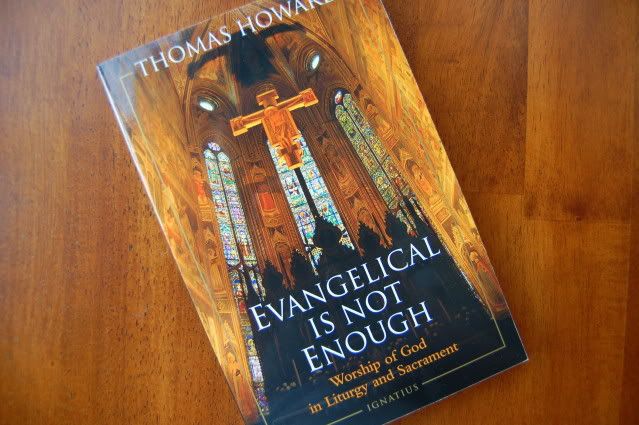
book of the week | evangelical is not enough

-
Photobucket
-
week five | book of the week | evangelical is not enough

-
I first heard about Evangelical is Not Enough: Worship of God in Liturgy and Sacrament through Elizabeth Esther's online book club. I was intrigued, but didn't bother to look into it further. Later in January, a friend mentioned something else about it and suggested that I read it, so I found a copy and delved into it. The book tells the story of Thomas Howard (who, incidentally, is Elisabeth Elliot's brother) and "his pilgrimage from Evangelicalism (which he loves and reveres as the religion of his youth) to liturgical Christianity."
-
As I've mentioned before, I have begun my own little journey towards the more liturgical traditions. But I still feel like so many of the reasons I am attracted to the liturgy and the sacraments are still fuzzy in my mind, for I was attracted to it all before I could even explain why. When the shocked girls in my ballet class inquired this past December why I was now attending the "boring" Episcopal church, I found it difficult to articulate my answer. So I hoped reading Thomas Howard's journey would help clarify my own journey somewhat. And I think it did.
-
Having said that, let me mention that I really don't feel like I read this book closely enough. It's on my "need to read again" shelf. But that's the case primarily because it was such a good book, one that I think held more in it than I was able to comprehend in one week (and in the early mornings, no less, when my primary goal was just trying to keep my eyes open).
-
The book is directed towards Evangelicals who have an interest in the liturgical church and who have perhaps grown weary with some aspects of Evangelicalism. There are a lot of books out there today that seem to address people who have "grown weary with Evangelicalism." But I think one of the things that makes this book unique is that Howard clearly expresses his appreciation and respect for the Evangelicalism of his youth. He does not immediately start discussing all the wrong things about Evangelicalism, but rather states right away that his "debt to Protestantism is incalculable." And he carries this same attitude throughout the entire book--he discusses the reasons he is drawn to liturgy with an appealing honesty and grace towards all.
-
In the first chapter, Howard takes a moment to define Evangelicals. I found rather amusing the list of "touchstones" he uses to explain the Evangelical identity--perhaps because it is all so familiar--everything from Billy Graham and Wheaton College to an emphasis on the Second Coming or missions. The rest of the chapters deal individually with different aspects of of the liturgical tradition that attracted him, from ordered prayer to worship as an act rather than an experience. See the full list of all of the chapters below.
-
I do not have the time or the space to write about the specific ways this book has helped to clarify my own journey towards liturgy, so I am thinking that perhaps I will have to start in the future a little series of posts listing some of those reasons (for my own sake, mostly--then I'll know how to answer people better!). But if you'd like to read more about the book, there is a lot of information and discussion over at Elizabeth Esther. And no doubt you'll see me quoting from it again in the near future--it is a book I find myself returning to over and over.
-
Book Information:
Published in 1984 by Ignatius Press
158 pages
10 chapters:
---1. Protestant and Evangelical: Understanding Ourselves
---2. Spirit and Flesh: Surrendered Forever or Reunited?
---3. Christian Worship: Act or Experience?
---4. Prayer: Random or Disciplined?
---5. Hail, Blessed Virgin Mary: What Did the Angel Mean?
---6. Ritual or Ceremony: A Dead Hand or the Liberty of the Spirit?
---7. Table and Altar: Supper and Sacrament
---8. The Eucharistic Liturgy: Diagram and Drama
---9. The Liturgical Year: Redeeming the Time
---10. Envoi
Postcript, Notes, & Further Reading
Price: $10.36
-

Sunday, February 21, 2010

book of the week | miriam's kitchen

-
Photobucket
-
week four | book of the week | miriam's kitchen
-
My sister somehow had two copies of Miriam's Kitchen by Elizabeth Erlich, so she kindly gave one to me. This memoir, about a woman returning to the Jewish traditions of her ancestors, had been sitting atop my bookshelf for some months. It wasn't a book I had chosen or that I was particularly drawn to, but it was sitting there waiting to be read, so I picked it up at the end of January.
-
If anything drew me to it, though, it was the following quote from the introduction that my sister had e-mailed me some weeks before, when she began reading it herself: "Yet serious cooking is an essentially optimistic art. It reaches into the future, vanishes into memory, and creates the desire for another meal." This enchanting view of cooking is embedded into the very core of the memoir. And the traditional kosher kitchen of Erlich's mother-in-law becomes the central setting.
-
Throughout the memoir, Erlich recounts small snapshots of her life as a young girl growing up in a partially-committed Jewish family, one that was slowly falling away from the traditions of the faith. As she grew older and left home, she separated herself almost entirely from her family's faith. It was not until she married and met her mother-in-law, Miriam, that she slowly began to return to Judaism, to the traditions of her past, to her family's history, and to the kosher kitchen.
-
The memoir is organized by the months of the year, beginning in September and going through each month with small essay-type chapters on varying topics and interspersed with her family recipes. However, the memoir is not chronological whatsoever; Erlich will jump from one essay-chapter about her life as a child to another essay-chapter about her grandmother's childhood. But it was all done seamlessly and the hopping from one time period to another blended easily into the story of how Erlich became increasingly attracted to the values and traditions of Judaism.
-
Ultimately, though, it was Miriam in her kitchen that drew Erlich back. She writes, "It has always been the religion of the home that compelled me, not that of the public sphere. My felt heritage was kitchen, and holiday, and attitude, the atmosphere that my grandmothers were able to protect and transmit, against odds, through time." Above all, Erlich clearly treasures the small moments and traditions of life most. "I am struck, as always, by the small things," she writes.
-
As unfamiliar as I am with the daily rituals and life of a Jewish family, this proved to be a helpful introduction. And while perhaps it wasn't the most compelling read, it certainly aroused in me a greater admiration for the small things of life, for traditions and heritage, and for the the ever-optimistic art of cooking.
-
Book Information:
Published in 1997 by Penguin
361 pages
13 chapters:
---1. September - Longing
---2. October - Diaspora
---3. November - Native Ground
---4. December - Inheritance
---5. January - Obligation
---6. February - Observance
---7. March - Miracles
---8. April - Female Religion
---9. May - Decisions
---10. June - The Life Force
---11. July - Community
---12. August - Words and Deeds
---13. September - Continuity
Introduction
Price: $10.88
-

book of the week | welcome to the church year

-
Photobucket
-
week three | book of the week | welcome to the church year by vicki k. black

-
Beginning at the end of last summer, I have started to try to order my life more and more around the church calendar: the different seasons of Advent, Epiphany, Lent, Easter, Pentecost and so forth. But growing up in a church that did not follow the church seasons except for Easter and perhaps a mention of Advent, the language of the liturgical church year was unfamiliar to me. Nor did I fully understand the purpose behind it. I attended the services, listened closely, and tried to gather as much information as I could. But I still felt like I did not fully understand.
-
And honestly, I still do not fully understand. But since last summer, I have come across several resources that have been helpful in developing my understanding of the liturgical church year more and more. One of these is a book I picked up at my church's library entitled Welcome to the Church Year: An Introduction to the Seasons of the Episcopal Church by Vicki K. Black.
-
It is a very basic, straightforward, chronological guide to the church year. Black first covers the purpose behind the church year and why the celebration of time and tradition is important. She then addresses each individual season, discussing the themes, traditions, services, and liturgy for each. She intersperses scripture and liturgy throughout and there are several questions for discussion at the end of each chapter. It is indeed purely an introduction--for someone who has not grown up in a liturgical church and who is not at all familiar with the church year. But while it is basic, I found it very helpful in my own understanding of the different church seasons.
-
Book Information:
Published in 2004 by Morehouse Publishing
126 pages
8 chapters:
---1. Welcome to the Church Year
---2. Advent
---3. Christmas
---4. The Epiphany
---5. Lent
---6. Holy Week
---7. Easter to Pentecost
---8. The Season of Pentecost
Price: $11.20
-

Sunday, January 31, 2010

book of the week | living the sabbath

-
Photobucket
-
I am still quite behind on my weekly book reviews. I read this book the second week of the year. Reviews on my other January books coming shortly, I hope!
-
It is Sunday evening as I write this. I spent the day resting. I slept in somewhat late after a long evening last night. I went to church. I came home and ate and did nothing in particular. I watched a movie with my family. I re-organized my morning room and stared at my books for awhile. I flipped through a few magazines. I prepared and planned for the week ahead. I did some laundry. I read and prayed.
-
One of my resolutions for two thousand and ten was to finish all of my homework by Saturday night each week in order to have a day of complete rest on Sunday. Days like today remind me of how grateful I am to have made this decision
-
(Perhaps I should mention, though, that while it makes for some lovely Sundays, it also makes for some rather miserable Saturdays as I scrunch in all my homework! But at least my sister, who had a lot of homework herself on Saturday, was here to commiserate with me. We found some ways to procrastinate together, though, such as redesigning her blog.)
-
In any case, I picked up Living the Sabbath: Discovering the Rhythms of Rest and Delight by Norman Wirzba two weeks ago in hopes that it would encourage and enlighten my pursuit of seeking sabbath rest. I anticipated the book would discuss the need for setting aside a day of complete rest, but instead I found the book's thesis focused on not just abstaining from work on Sunday, but rather what it looks like to live out the principle of sabbath rest throughout the entire week. Wirzba transforms the Old Testament law of setting aside a single day into a New Testament principle that should characterize our entire lives--one that often goes unnoticed in our modern church, it seems.
-
The main theme that runs throughout the book is the need to slow down, to worship in the ordinary moments, to realize our dependency on God, to see our work as worship, to take delight and pleasure in the gifts of God. As Wirzba writes, "The Sabbath asks us to notice. It compels us to reconsider and question with depth and seriousness what all our striving is ultimately for" (38). Our lives are so often characterized by this endless pursuit for more--more money, more pleasure, more knowledge, more popularity. Wirzba carefully and thoughtfully reminds us that there is another way, that this striving for earthly pleasure is not what God intended for us.
-
At first I questioned how this all related to the Sabbath. The foreword by Wendell Berry and the repeated mentions of environmental issues and the critical analysis of our current food production (in the first chapter, no less) made me skeptical at first; perhaps this author simply has an agenda, I questioned. But the more I read and the more I thought about it and the more I go back over my notes and underlined passages, I am beginning to see the absolute importance of his message from a scriptural perspective.
-
I cannot go into every detail of the book, obviously, but I want to quote one passage that especially stood out to me. In part one, Wirzba discusses the need for Sabbath living and then in part two discusses the practical manifestations of living out the principle of the Sabbath. There is much to mull over throughout the book and I definitely think it merits more than one reading, but the one chapter that struck me more than all the rest was the one on Sabbath worship.
-
Wirzba writes in this chapter, "We have divorced worship too much from our everyday lives and placed it in a purely spiritual realm, not realizing that in doing so we have rendered it abstract and anemic, cut off from the flows and patterns of daily life. Rather than having our worship grow seamlessly and spontaneously (more honestly?) from the activities we perform daily, we have confined it to special buildings and times that are susceptible to the fabrication and hype--the deceit of vainglorious and "empty words" (Eph. 5:6)--of the moment" (159).
-
There are so many other treasures of thought-provoking wisdom in this book and I plan to write more about what I have gleaned and am gleaning from Wirzba's words in the future. But for now, I encourage you to find a copy yourself and sit down prepared to learn. It is not at all what I had expected it to be, but, as so often happens, I found that it is exactly what I needed to hear.
-
Book Information:
Published in 2006 by Brazos Press
165 pages
12 chapters:
---1. Losing Our Way
---2. The Meaning of the Sabbath
---3. From Sabbath to Sunday
---4. The Practice of Delight
---5. The Decline of Delight
---6. Pain and Suffering
---7. Work and the Sabbath
---8. Sabbath at Home
---9. Sabbath Economics
---10. Sabbath Education
---11. Sabbath Environmentalism
---12. Sabbath Worship
Part One: Setting a Sabbath Context | Part Two: The Sabbath in Practical Context
Foreward by Wendell Berry
Preface
Price: $17.09
-

Saturday, January 23, 2010

book of the week | till we have faces

-
Photobucket
-
Along with my resolution to read a book a week in 2010, I hoped to find the time to write a few thoughts about each book on here as I finished them. And while I am (almost) on track with the reading aspect, I fell a bit behind these first few weeks in writing about the books. So, a bit belatedly, here are some thoughts on
Till We Have Faces: A Myth Retold by C.S. Lewis, which I read the first week of the new year.

Also, I want to mention that I did originally write this for a class, so please excuse my authoritative tone. I honestly have not read any literary criticism on Lewis's book, so my understanding of the novel might not always be accurate. This is simply how I interpreted the book.
-
I have heard from several sources that C.S. Lewis claimed that Till We Have Faces was his own favorite book of all that he had written. So it was with anticipation that I first opened the novel. Immediately, though, I noticed this book was unlike any of his other books. It still held the themes that will always be associated with Lewis--longing and desire and the nature of love--and it contained symbolism, like so many other of his novels, and yet it was heavier, deeper, more grotesque, if you will. But even amidst its depth, or perhaps because of it, I found the novel enchanting.
-
The book is a retelling of the Greek myth of Cupid and Psyche. Lewis altered the myth slightly to fit his purposes: he set the events in a different time period and place (a fictional, pre-Christian country near Hellenistic Greece), he added a few characters, and he developed his own theme. But for the most part, the novel is faithful to the original myth. The story tells of the ugly Orual who possessively loves her younger sister, Psyche. It is written in the first person from the perspective of Orual. Book one is her "accusation of the gods," in which she claims the gods have stolen Psyche's love from her. In book two, however, Orual reflects on her previous writing and tells how she has changed and how she believes what she wrote in the first half of the novel is all wrong--that it was herself, not the gods, who were to blame. The novel ends mid-sentence, and there is an after note that says Orual collapsed and died as she wrote.
-
As in many other of his novels, Lewis uses much symbolism. It is the case here also, though perhaps not so obvious. However, I want to write about two symbols, mainly because they illuminated to me the theme of the novel.
-
At the beginning of the book, the traits of a Christ figure become immediately apparent in the character of Psyche. She is described as supremely beautiful and innocent. She has miraculous powers and people flock to her so that they may be healed by her touch. And eventually, when the land of Glome has been scourged by disease, war, and lions, the people sacrifice her to the gods as she is the only one who is an image of perfection and worthy to be sacrificed in their place. She is hung on a bare tree and left to die. Her perfection, miraculous powers, and sacrificial death clearly mirror a Christ-life.
-
At the same time, however, she also is a symbol of a mortal seeking after truth. The name "Psyche" means "soul." Lewis himself said, speaking of Psyche, "She is in some ways like Christ because every good man or woman is like Christ." He clearly doesn't state that she is only a symbol of Christ, she is merely like Christ--and in her character, one can also see the elements of the human soul. For even amidst her perfection and beauty, she longs for "home," saying:
-
"The sweetest thing in all my life has been the longing--to reach the Mountain, to find the place where all the beauty came from...my country, the place where I ought to have been born. Do you think it all meant nothing, all the longing? The longing for home? For indeed it now feels not like going, but like going back. All my life the god of the Mountain has been wooing me. Oh, look up once at least before the end and wish me joy. I am going to my lover. Do you see now--?" (76)
-
This longing for home--or as Lewis believed, heaven--is something he believed characterized every human soul. In one of his more famous quotes, he says, "If I find in myself desires nothing in this world can satisfy, the only logical explanation is that I was made for another world." Accentuating his oft-used theme, Psyche's longing for "the place where all the beauty came from" clearly symbolizes her as a mortal and reminds us of our own longings for another world.
-
Another striking symbol in the novel is the veil that Psyche's sister, Orual, wears in the latter half of the book. Orual constantly speaks of her own ugliness and the veil is her way of covering up her unattractiveness. But there seems to be a deeper meaning to the veil. One of the main themes of the novel, as expressed in the title, is that we cannot understand the intent of the gods--or God--until we see them ourselves. At the end of the book, Orual says:
-
"I saw well why the gods do not speak to us openly, nor let us answer. Till that word can be dug out of us, why should they hear the babble we think we mean? How can they meet us face to face till we have faces?" (294)
-
The veil, therefore, is a symbol of our own veiled faces--of how humanity cannot fully see, cannot fully understand. Of how we are blinded to the supernatural world that invisibly walks among us. At the very end of the novel, when Orual finally sees the gods and the world and herself for what they really are, Orual writes, "Hands came from behind me and tore off my veil--after it, every rag I had on" (289). In the presence of the gods, her veil is torn from her and her vision is restored. She sees, understands, comprehends.
-
I also found, besides the symbolism, that the first-person point of view furthered the themes of the novel. In the first part of the book, as we see through Orual's eyes, we feel partial to her--we too feel angry with the gods for screwing up her life when she seems so innocent. While perhaps here and there we might question her actions or accusations, for the most part the reader feels the same hatred that Orual feels at the end of book one.
-
In book two, Orual still speaks in the first person, but in a more humble, reflective way. Looking back on the tale that she told in book one, she perceives herself how possessive her love was towards others, how it was she who so often birthed the problems she faced. Through the first person, we too see how self-favoring and one-sided our understanding of the world so often is. We enter into Orual's journey and become like her, in a sense, traveling with her through anger and hardening and ultimately into a sort of shocked and humble repentance in the presence of the gods.
-
It was these things--the symbolism and the perspective--that to me made the book deeper and more thought-provoking. But the story itself was captivating, the type of book that you set down and cannot wait to pick it up again. My first week back to school was quite often interrupted with extra long lunch breaks! Lewis once again wrote a purely enjoyable novel.
-
And while this might sound contradictory, I think one of the most surprising elements to me in Till We Have Faces is how little specific Christian symbolism Lewis used. I've highlighted the main ones--and really, Psyche's sacrificial death is the only obvious one. A reader could certainly enjoy the book without knowing anything of Lewis's background. And I think is one of the main reasons the book appeals to me. It is not so straightforward. It is graver, more intense, even more confusing than his other novels. I opened up the first page and was daunted by the host of strange mythical names and the foreign, barbaric setting, but eventually, the novel wove itself into me--and now, two weeks after I finished it, I am still trying to wrap my mind around the themes and nature of the novel. It is the type of book that merits more than one reading.
-
And lastly, I think one could say that the book might be summed up in one of my favorite Bible passages, I Corinthians 13:12, "Now we see but a poor reflection as in a mirror; then we shall see face to face. Now I know in part; then I shall know fully, even as I am fully known."
-
Book Information:
Published in 1956 by Harcourt Books
313 pages
Book One: 21 chapters | Book Two: 4 chapters
Note from C.S. Lewis at the end outlining the original myth of Cupid and Psyche
Price: $10.08
-

Friday, August 21, 2009

summer reading

This afternoon was a perfectly rainy, summer day for reading. There was thunder in the distance and the pitter-patter of rain against my window. The clouds were heavy and dark and my room was silent and dim with a candle lit on top of my bookshelf. I dragged my cream wing chair to face the window and snuggled down for one of my favorite summer pasttimes. So lovely.

Photobucket
---

Photobucket


At the beginning of summer, I made myself a rather daunting book list. 30 books. The summer's end is nearing and I am still quite far from finishing all 30, but I plan to continue on with these books until I do finish them...hopefully sometime in September or October.
-

-
"There is no Frigate like a book,
To take me lands away..."
(Emily Dickinson)
-
oh, the joy of a good book, a quiet room, and a rainy day!
-
grace & peace,
Jessina